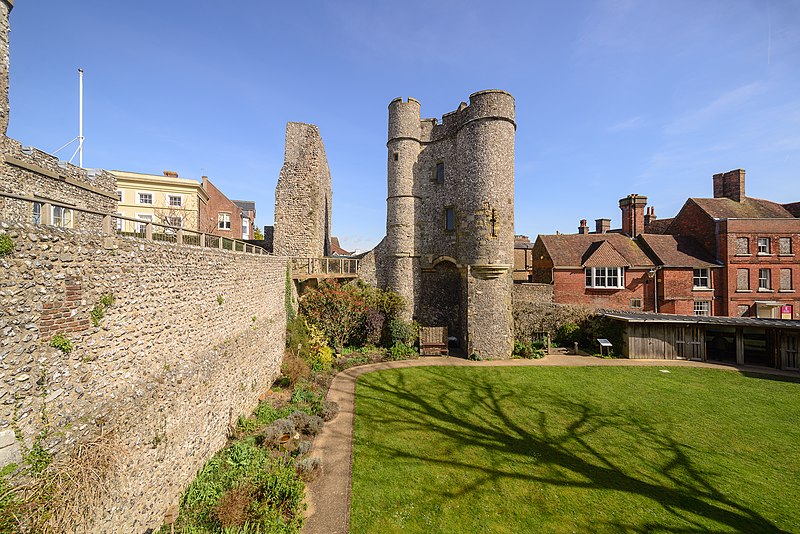
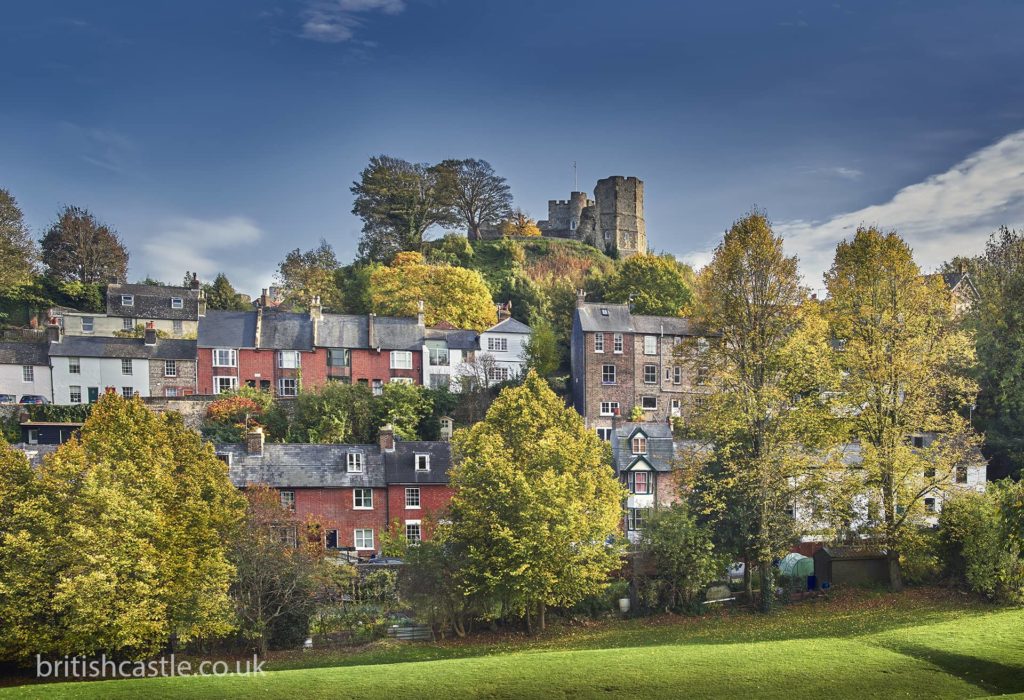
Lewes Castle stands on a chalk mound above the town of Lewes and the River Ouse in East Sussex, reached off a side street from the High Street. Raised soon after the Norman Conquest, it is one of only two castles in England built with two mottes rather than one; the other is Lincoln.
Lewes Castle History
The castle was begun by William de Warenne, a leading Norman lord granted the Rape of Lewes after 1066, around 1069 to 1070 in the motte-and-bailey style. He and his wife Gundrada also founded Lewes Priory nearby, the first Cluniac house in England, and he was made 1st Earl of Surrey shortly before his death in 1088.
The earliest defences were timber. A tower and palisade stood on Brack Mount, the smaller motte at the north-east of the oval bailey, of which only fragments survive; the larger motte to the south-west carries the later stone keep. It is this two-motte plan that makes Lewes unusual, shared in England only by Lincoln.
In the late 12th century Hamelin de Warenne, Earl of Surrey, replaced the timber work on the south-western motte with a circular flint shell keep, roughly 110 by 100 feet. A shell keep is a ring of wall around the top of the motte with buildings set against the inside, rather than a single central tower. Fragments of knapped flint in herringbone masonry, an early 12th-century technique, still remain.
The Battle of Lewes
The castle gives its name to the Battle of Lewes on 14 May 1264, one of the decisive clashes of the Second Barons’ War. The quarrel began when Henry III went back on the Provisions of Oxford, the reforms he had agreed with the barons in 1258. On the day the King lodged at St Pancras Priory with the infantry, while his son, the future Edward I, held the castle with the cavalry.
Simon de Montfort, Earl of Leicester, seized the high ground of the Downs in a night march. Edward drove back the troops facing him but pursued them too far, and Montfort turned on the rest of the royal army. With both King and Prince taken, Montfort became the effective ruler of England. To win his release Henry sealed the Mise of Lewes, a settlement now lost, which set up a council of knights and townsmen often seen as a forerunner of the House of Commons. Edward escaped the next year and defeated Montfort at Evesham in 1265, ending the experiment.
The Barbican and Later Centuries
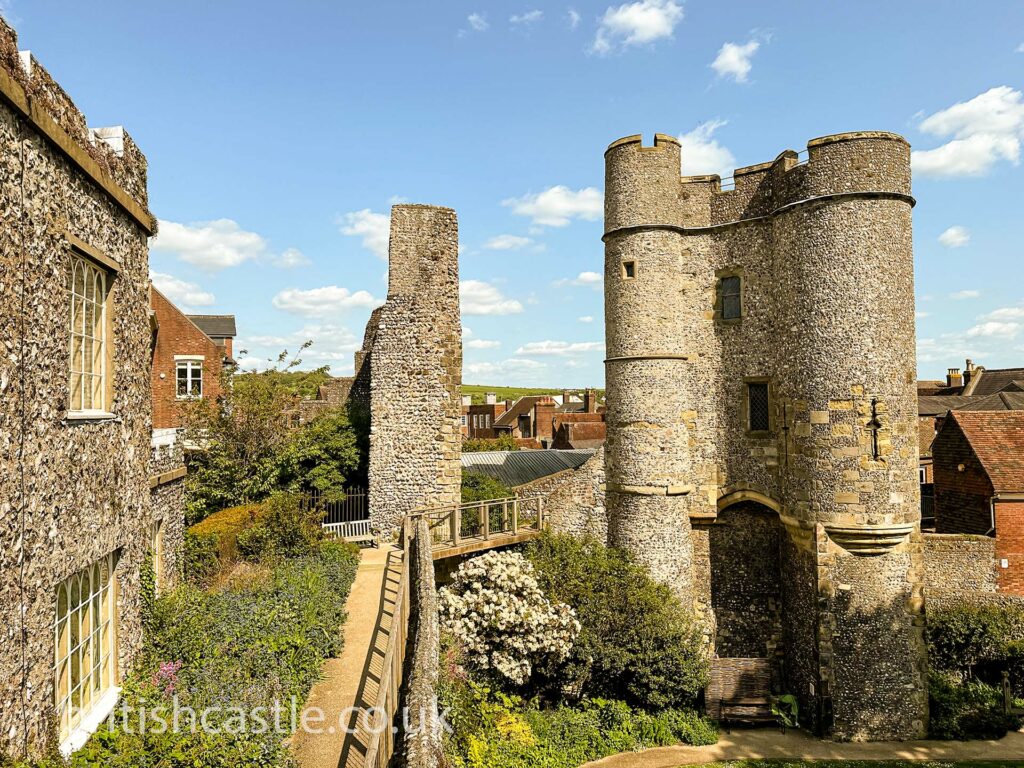
Two semi-octagonal towers were added to the shell keep late in the 13th century. The castle’s finest surviving feature, the barbican, followed in the early 14th century: a tall gatehouse with a narrow arched entrance and machicolations for dropping stones on anyone below. It was the work of John de Warenne, 7th Earl of Surrey, the last of the Warenne line, who died without a legitimate heir in 1347. The castle then passed to the FitzAlan earls of Arundel, who let it decay, and a riot not long after did further damage. For years townspeople took stone from the ruins to build with.
Much of what was left was pulled down in 1620, though the keep was spared. It passed to Thomas Friend in 1733 and was fitted out as a summer house in 1774, when the arrow slits in the West Tower were replaced with Gothic windows. A spiral staircase in the South Tower still climbs to the roof. During the Second World War the castle served as an Observer Corps lookout.
Visiting Lewes Castle
Lewes Castle has been in the care of the Sussex Archaeological Society since it leased the site in 1850; Charles Thomas-Stanford bought the freehold and gave it to the Society in 1922. The Society runs the Barbican House Museum by the castle gate, and a joint ticket covers the nearby Anne of Cleves House. The keep is open through the year, and the climb is paid off with wide views over the town and the South Downs.
If you are touring the county, it sits within easy reach of the other East Sussex castles, Bodiam and Hastings among them.