Prudhoe Castle is situated in the Tyne valley in the town of Prudhoe in Northumberland. It stands on a steep ridge overlooking the River Tyne and is surrounded to the west and south by a deep 13th century moat. It was originally built to stop Scottish invaders crossing the river and invading England.
The castle was constructed in a figure of eight shape with an inner and outer bailey. These are now separated by a Georgian manor house built during the early 19th century which houses a museum detailing the castle’s history.
The 1.5 metre thick curtain wall with barbican surrounding the inner ward is largely intact and it is within here that you can see the ruined square keep with its 10 feet thick walls. Originally built as a 2 storey structure in the 12th century, it was later extended to provide a level with turrets. The inner ward also contains two 13th century rounded towers, one of which remains in remarkably good condition.
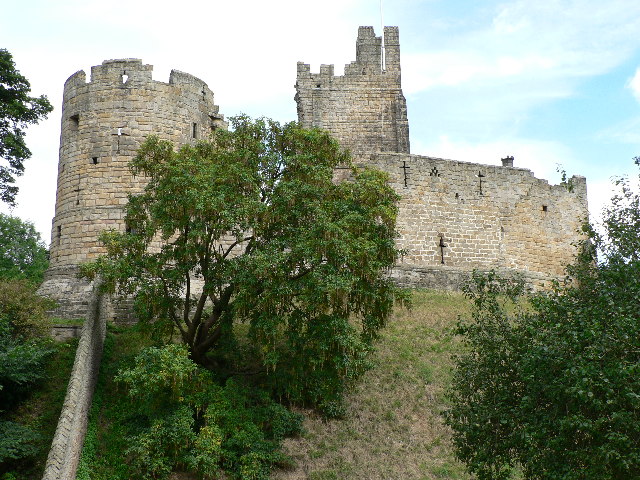
The outer ward contained, amongst other buildings, the great hall which was built against the north curtain wall. Unfortunately little but the foundations of this once magnificent structure remain today. The one building in the outer ward that has survived reasonably unscathed is the 12th century gatehouse.
Prudhoe Castle is maintained by English Heritage and is open to the public daily, excluding Tuesday and Wednesday, from late March to the end of September.
The sieges of Prudhoe Castle
For most of the medieval period Prudhoe was held by the Umfraville family, granted the barony by Henry I. Its position guarding the Tyne made it a target in the long wars between England and Scotland, and it earned a rare distinction: Prudhoe is the only castle in Northumberland never taken by the Scots.
In 1173 William the Lion, King of Scots, invaded northern England to press his claim to the earldom of Northumberland. Odinel de Umfraville refused to back him, and the Scottish army turned on Prudhoe. The siege failed, as William’s forces were not equipped for a drawn-out assault.
William returned in July 1174 and besieged the castle again, this time for several days. Odinel had spent the intervening months strengthening the defences, and when he rode out to raise a relief force of knights the Scots abandoned the siege and withdrew. Days later, on 13 July 1174, William was defeated and captured at the Battle of Alnwick, ending his campaign.
The Umfravilles held Prudhoe until the late 14th century, when it passed by marriage to the Percy family, Earls of Northumberland.
That kills the gibberish and adds roughly 200 words of accurate, on-topic history, which also nudges this page off the “thin” list.