High up on the cliffs on the wild Atlantic coast of north Cornwall stand the ruins of Tintagel Castle. Its romantic associations with the legend of King Arthur and his Knights of the Round Table makes this an intriguing place to visit, although Geoffrey of Monmouth, who wrote that King Arthur was conceived here, was writing well before the time that the castle was built.
It’s thought that Tintagel Castle became so inextricably linked with the legends of King Arthur that a succession of owners decided to keep the legends alive and maintain the tenuous links despite not being able to base them on historical fact.
Tintagel Castle and the legend of King Arthur
The Arthur connection begins with Geoffrey of Monmouth, whose History of the Kings of Britain, written around 1136, tells how Uther Pendragon desired Igerna, wife of the Duke of Cornwall. Disguised by Merlin’s magic as her husband, Uther entered the fortress at Tintagel, and Arthur was conceived that night. Geoffrey never claimed Arthur was born or lived here, but the story stuck, and later writers turned Tintagel into Arthur’s birthplace.
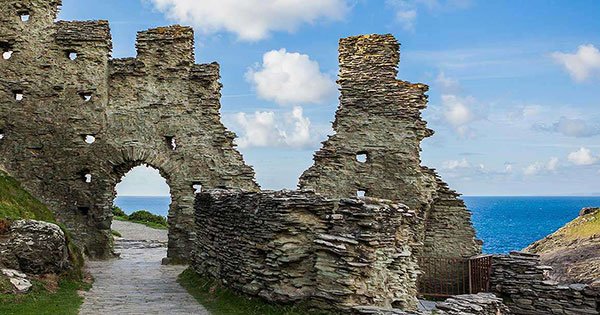
The legend has shaped the site ever since. When Richard, Earl of Cornwall built his castle here in the 1230s, the place already had no military value. Building on the spot of Arthur’s conception was a statement of prestige, and the castle’s deliberately old-fashioned style played up the connection.
The Victorians revived the legend for a new audience. Tennyson’s Idylls of the King brought tourists to the village in numbers, and the Arthur industry has never left. On the island today stands Gallos, an eight foot bronze sculpture of a hooded, half-formed king, installed in 2016. Below the island, reachable from the beach at low tide, is Merlin’s Cave, named for the wizard who in later tellings carried the infant Arthur from the waves.
What the archaeology really shows
The real history of Tintagel is arguably more remarkable than the legend. Excavations have shown that between the 5th and 7th centuries, after Roman rule ended in Britain, the island was a stronghold of the rulers of Dumnonia, the kingdom that covered Cornwall and Devon. Archaeologists have found the remains of scores of buildings from this period, along with the largest collection of post-Roman Mediterranean pottery ever found in Britain. Wine and olive oil were arriving here from the Eastern Mediterranean in exchange for Cornish tin, at a time when most of Britain had fallen out of long-distance trade altogether.
The name itself is ancient: Din Tagell, the fort of the narrow entrance, describes the constricted neck of land that was once the only way in.
When Ralegh Radford excavated the site in the 1930s he interpreted these remains as a Celtic monastery, and that theory held for decades. Later excavations overturned it: the imported luxury goods and the sheer scale of the settlement point to a secular royal site, not a religious one. English Heritage’s own research excavations in 2016 and 2017 uncovered further substantial buildings, with slate floors and pottery and glass from as far away as Turkey and Spain.
In 1998 archaeologists found a broken slate bearing a 6th or 7th century inscription, including the name Artognou. The press immediately dubbed it the Arthur stone, but the inscription does not mention Arthur, and the archaeologists who found it were clear that the name is not his. What the stone really proves is more useful: people at Tintagel in this period were literate, Latin-writing and high-status, exactly when Geoffrey’s legend places a great ruler here.
Tintagel Castle Photos
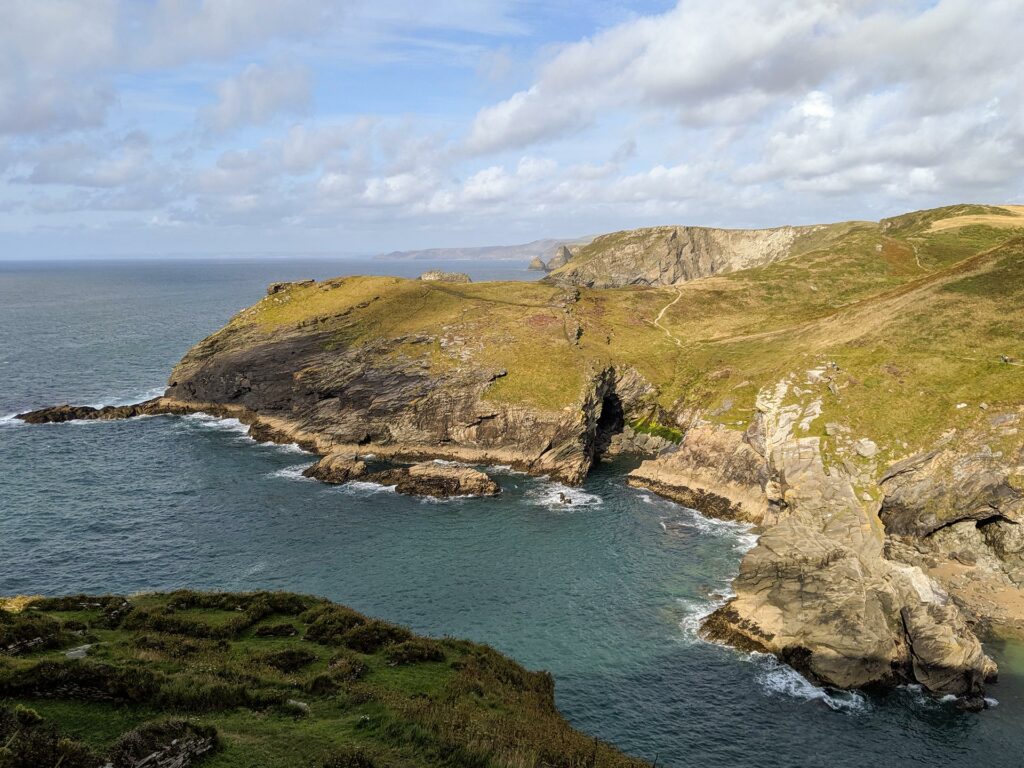
The medieval castle
The ruins you see today belong to a castle begun in the 1230s by Richard, Earl of Cornwall, younger brother of Henry III and one of the richest men in Europe. Richard acquired Tintagel by exchanging three of his manors for it in 1233, a poor bargain in land terms that only makes sense as a purchase of the legend. The site had no strategic value and the castle was never seriously fortified or garrisoned.
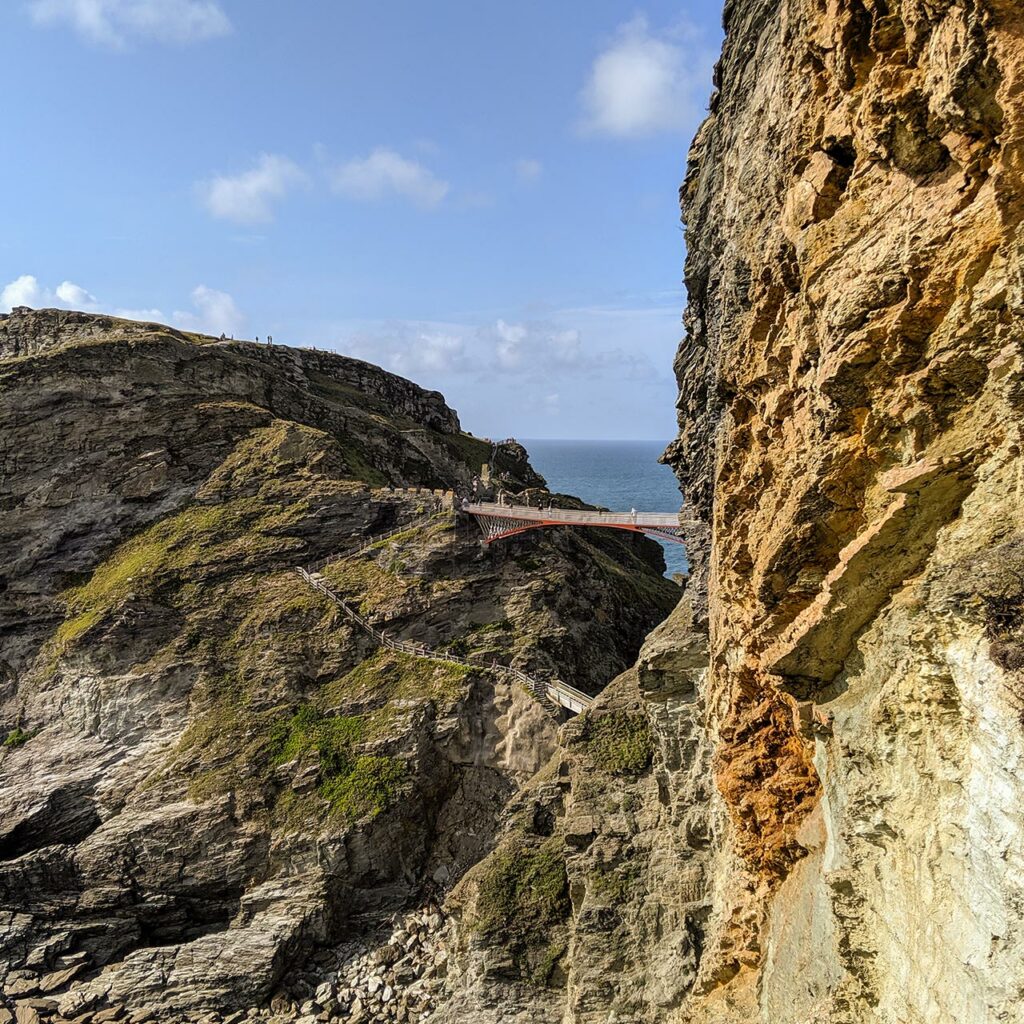
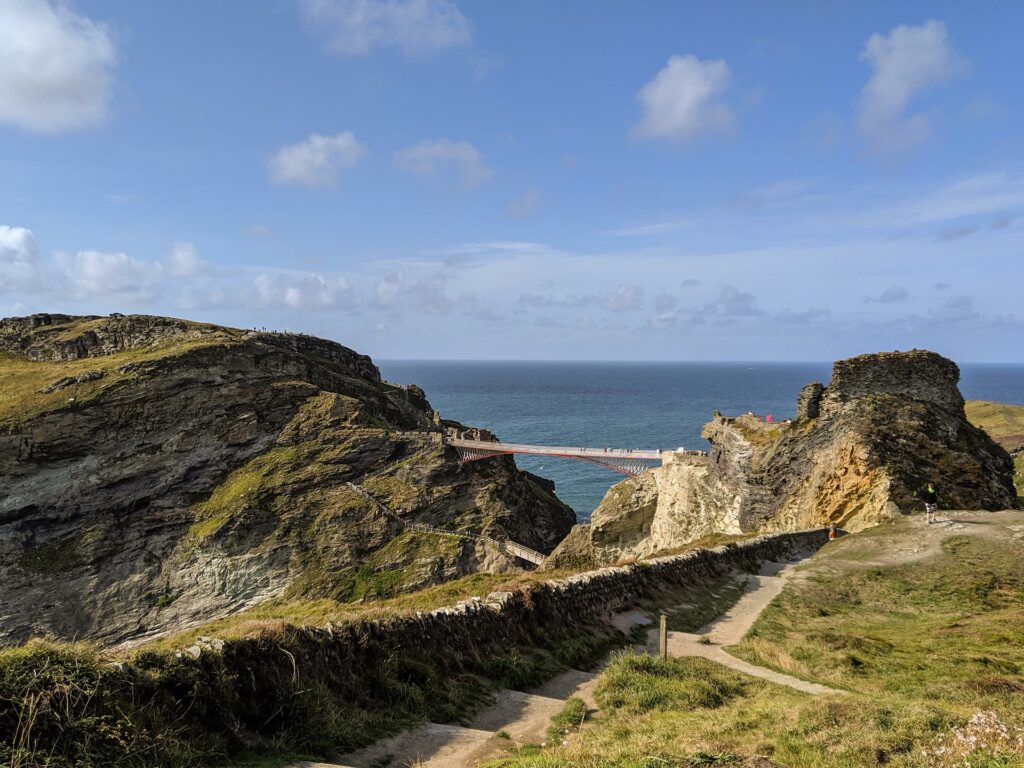
The castle originally spanned the mainland and the island, joined across the narrow neck of land. Erosion and landslips later carried away the connection, splitting the ruins into the two halves visible today.
Later Earls of Cornwall had little use for it. By the middle of the 14th century the great hall was unroofed, and apart from a spell when the castle was used as a prison, it was left to decay. By the 15th century Tintagel was a ruin, and it stayed that way until the Victorians rediscovered it.
Whatever the facts behind the legend of King Arthur, Tintagel Castle will no doubt always be associated with the King and his Round Table, and is probably one of the reasons why it is one of the historic castles of the UK held in such great affection by the British.
Visiting Tintagel Castle
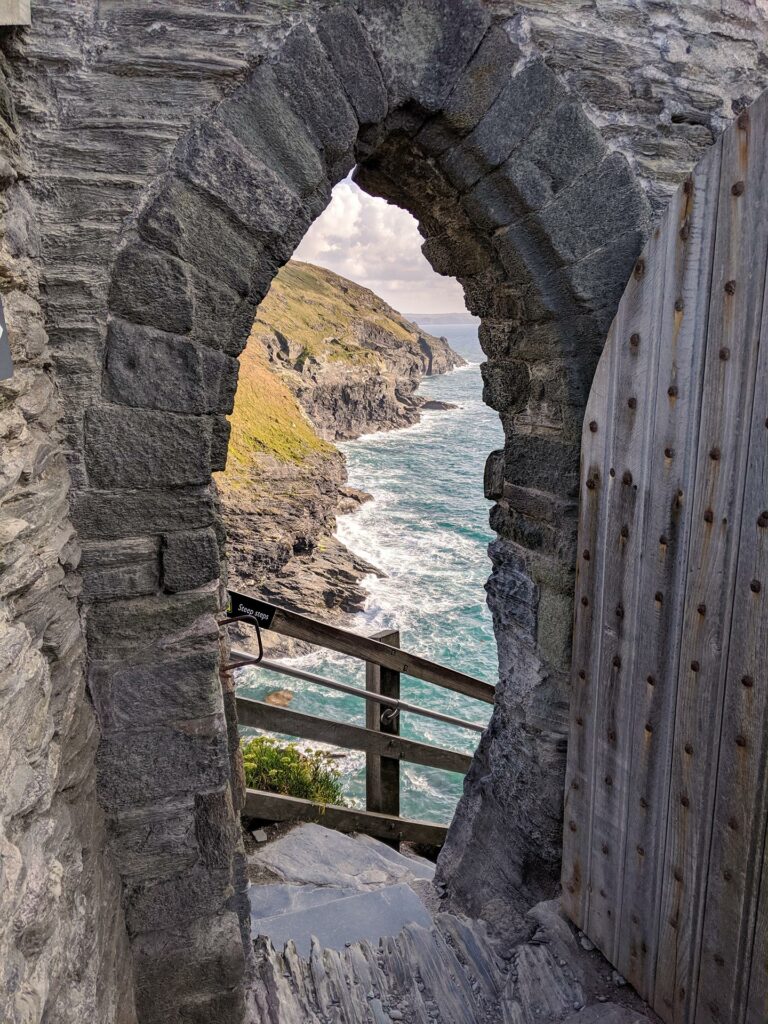
Tintagel Castle is cared for by English Heritage and sits on the coast at Tintagel village in north Cornwall, between Bude and Padstow. Since 2019 a striking cantilevered footbridge has crossed the gorge between the mainland and the island, recreating the land link that erosion destroyed centuries ago, so you no longer have to take the steep steps both ways. The island paths are still steep and uneven in places, and it is very exposed in bad weather.
At low tide you can get down to the beach and into Merlin’s Cave beneath the island. Allow around two hours for the castle, island and beach, longer if you linger over the views along the coast. Opening times and admission details are on the official English Heritage Tintagel Castle page.
The village itself is worth a wander, including the Old Post Office, a 14th century longhouse cared for by the National Trust.