York Castle was one of two castles William the Conqueror raised in the city in 1068, thrown up as he marched north to crush rebellion against Norman rule. It began as a motte and bailey: a great earth mound topped by a wooden tower, with a walled courtyard, or bailey, below.
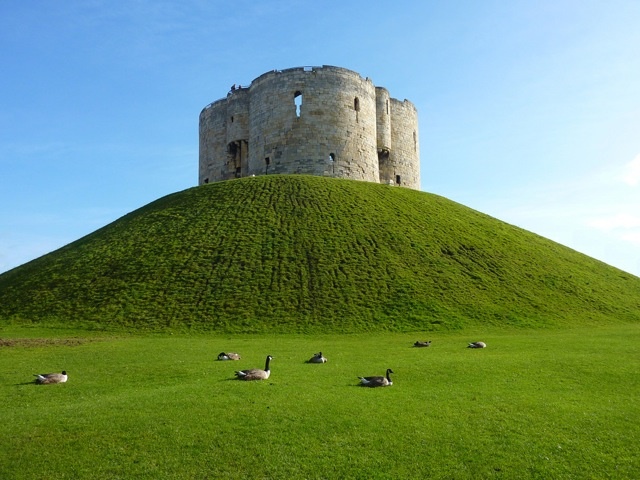
The wooden tower is long gone, but the mound survives, and on top of it stands the stone keep known today as Clifford’s Tower. When people say they are visiting York Castle, this is almost always what they mean.
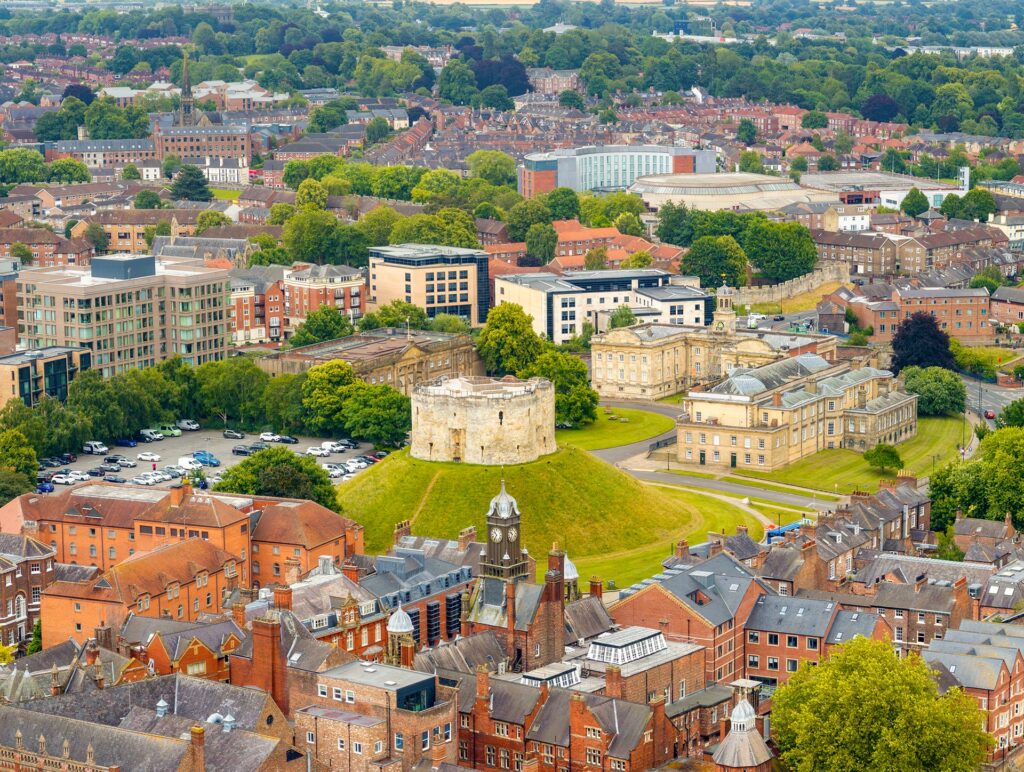
The castle’s old bailey, meanwhile, was rebuilt in the 18th century as a prison and courts, and those buildings now house York Castle Museum, a separate attraction a short walk from the tower. Clifford’s Tower on its mound, and the museum in the former prison below, giving you two things to visit, for one medieval castle.
The massacre of 1190
The darkest chapter in the castle’s history came in March 1190. Around 150 of York’s Jews, facing mounting violence in the city, took refuge in the castle’s wooden tower under royal protection. Besieged by a mob and with no safe way out, many chose to take their own lives rather than be killed or forced to convert; heads of families killed their wives and children before turning on themselves, and the tower was set ablaze. Those who tried to surrender were murdered anyway.
It remains one of the worst antisemitic atrocities in English history. A plaque at the foot of the mound commemorates the dead, and the daffodils that flower on the motte each spring, around the anniversary, are often planted in the shape of a six-pointed star in their memory.
Clifford’s Tower and its clover-leaf design
The stone tower that stands today, first known as the King’s Tower, was begun in the 13th century under Henry III. Its design is what makes it unusual. Rather than a square or round keep, it has a quatrefoil plan: four overlapping circular lobes, like a four-leaf clover seen from above. It was the only keep in England built to this plan, modelled on a French tower at Etampes, near Paris.
The keep was a compact royal stronghold. It stood on the motte behind a curtain wall and moat, with a single entrance and walls three metres thick. The ground floor held a large guardroom and two smaller living rooms; a chapel sat on the first floor, and the king’s private quarters, along with offices for royal clerks and treasury officials, occupied the top floor, where the walls are thinner and the windows wider.
The name came later. It most likely remembers Roger de Clifford, a rebel hanged at the tower in 1322 after the Battle of Boroughbridge; the name “Clifford’s Tower” is first recorded in 1596. In 1684 a fire reached gunpowder stored inside and the resulting explosion blew out the interior, leaving the roofless shell that survives today.
History of York Castle
The site had a long past before the Normans arrived. It had served as a Roman cemetery, and there is evidence of Saxon and Viking settlement nearby, no surprise in a city that was the Viking capital of Jorvik.
After William the Conqueror,who also began the Tower of London, built the castle in 1068, its early years were violent, with attacks during further northern revolts before the region settled under Norman rule. Over the centuries that followed the castle served many roles beyond defence: a royal mint, a prison, a court and the administrative centre of the county of Yorkshire. As its military value faded, the bailey became the working heart of county government.
In the 18th century the bailey was rebuilt in grand neoclassical style as prisons and assize courts. The Debtors’ Prison of 1705 and the later court and prison buildings still stand around the open space known as the Eye of York, and since the mid-20th century they have housed York Castle Museum, best known for its recreated Victorian street, Kirkgate.
Visiting York Castle and Clifford’s Tower
Clifford’s Tower stands in the centre of York, a few minutes’ walk from the railway station and from York Minster. It is managed by English Heritage, and a recent restoration has added a roof deck and internal walkways, with wide views over the city and the Minster from the top of the mound.
York Castle Museum, in the former prison buildings a short walk away, is a separate attraction on a separate ticket, run by York Museums Trust. If you want both the medieval tower and the social-history museum, plan for the two.
York rewards a full day. The city walls, the Minster, the Shambles and the Jorvik Viking Centre are all within easy walking distance of the castle.
Opening times and admission for Clifford’s Tower are on the English Heritage website.
Clifford’s Tower is now in the hands of English Heritage. It is open to the public throughout the year, except for the Christmas and New Year holidays.