Motte and bailey castles were some of the earliest castles designs used throughout the medieval period. Sometimes referred to as mott and bailey castles, these were perhaps the original castle design.
Read on for interesting facts about motte and bailey castles. Or, find out more about what castles are.
Motte and Bailey Design
The principle design feature of Motte and bailey castles was, of course, as a defensive structure and to this end, its greatest attribute, height. It was the Vikings of northern Europe, during the latter part of the first millennium, who were amongst the earliest warriors to apply this edge to their castle building. They were able to erect towering castles not only upon high ground but also in places offering no such natural advantage.
Hill Forts
Defenders throughout the ages have long known of the benefits of holding fort from above. More often than not their strongholds were sited upon hill or cliff tops. Consider Edinburgh Rock where there has been a fortress since the dark ages.

Or Hadrian’s Wall or the Antonine Wall both of which follow the contours of the high ground, forts along the way most often placed at high points. Or earlier, by definition, the hill-forts of the iron-age that were strategically located upon naturally elevated land. Remnants of Maiden Castle in Dorset provide possibly one of the finest examples built in England.
Motte and Bailey
Such advantage was not always naturally available. Often the location of a settlement provided little in the way of raised terrain. Similar to hill-forts, though predominantly man-made, the Vikings began to construct their castle and buildings upon great mounds of earthworks, the motte. This they enclosed within a heavily fenced and fortified bailey.
Motte and Bailey Castle Diagram

If you need this for homework or a lesson, here is a free printable version: a labelled motte and bailey castle diagram and worksheet (PDF, two pages). Page one has every part labelled, page two is the same castle with the labels taken off to fill in yourself.
What is a motte?
The motte (an old word for a mound of clod of earth) was where the wooden keep would be built. This structure would have been home to the lord of the castle, with the rest of the residents living below in the area known as the bailey.
What is a bailey castle?
The bailey was a surrounded by fence, known as a palisade and this in turn was surrounded by a ditch called a fosse. These features combined to provide significant defensive advantages to the occupants within.
Normans
Credit should not be attributed solely to those dark-age northerners though. As they forced their terror upon the hapless victims of Britain and Southern Europe they also brought with them their culture.
It was the combination of the feudal system in France with many hundreds of powerful barons and lords fighting to keep control of their individual lands, often by way of large personal armies, the naturally flat plains of that part of the continent and the influx of the invading Vikings that necessitated the need for greater defences. These castles allowed the Normans to quickly consolidate their power following battles and territorial gains, ensuring their dominance over the regions they controlled.
It could be said it was the Norman’s who finessed this art of castle building, the construction of such often regarded in terms of art. A motte and bailey castle was not to be considered purely in terms of its functionality.
Indeed, some of the earliest records of motte and bailey type castles are to be found on the famous Bayeux Tapestry, dating from the 11th Century; castles at Bayeux, Dol, Rennes and Dinan each feature.
It was during the Norman Conquest that this type of castle design became far more widespread in England. In total it’s thought that around 1000 motte and bailey castles were built in England during this period of history. This extensive construction effort highlights the Normans’ strategic use of these castles to secure their hold over newly conquered territories.
Part of the reason for this was that they could be built quickly using locally sourced timber, allowing the conquering forces to build defensive structures for their forces as they advanced throughout the land. Typically, these castles could be completed in a matter of weeks, enabling rapid deployment in newly acquired areas.
Functionality
Functionality was key to the safekeeping of those inside. The construction of ditches and moats and the subsequent development of the motte presented a formidable challenge to opposing armies. Climbing the steep banks just to be met by a tall fence or pele with likely menacing objects or substances being dropped and thrown from above was hardly appealing. These defensive features were a decisive factor in the Normans’ conquest of the British Isles, providing them with a significant strategic advantage.
Arrows from afar were next to useless when attacking motte and bailey defences. Simply put, from the higher vantage return fire had a greater range. However, the fight was rarely one-sided. Trebuchets and mangonels, great catapults, could present serious problems to the defenders, especially those firing flamed projectiles towards the often wooden castle and buildings.
Fire wasn’t the greatest fear of the occupants of the motte and bailey castle, with their wooden keeps, or for that matter, forts and castles from any period. Siege was an enduring worry for those within. At least, a large bailey would allow plenty room for storehouses.
British Motte and Bailey Castles
It was primarily William the Conqueror, following his invasion of 1066, who introduced the motte and bailey castle to the British Isles though evidence of earlier Norman examples can be found at the sites of Hereford Castle and Richard’s Castle, near Ludlow, close the Welsh border.
During his subsequent reign it is thought 1000 or more motte and bailey castles were built throughout England and Wales by the Normans.

Some fine examples can be seen from Google maps’ aerial views of Castle Acre Castle and Castle Rising Castle, both in Norfolk, Berkhamsted Castle in Hertfordshire, Duffus Castle in Scotland and, probably most famous of all, Windsor Castle in Berkshire.
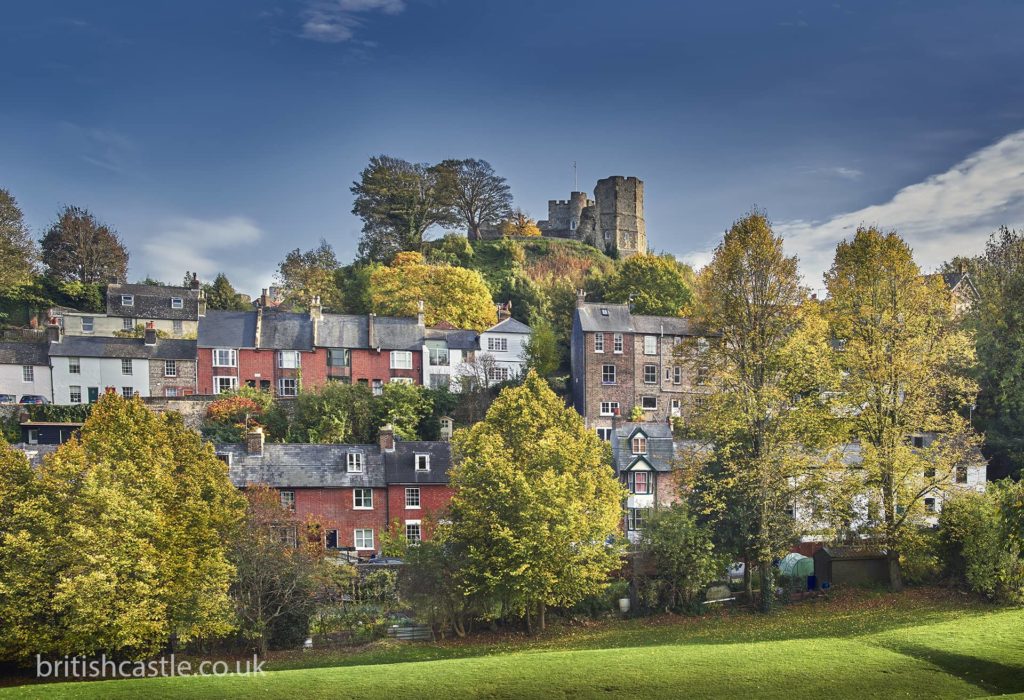
Windsor Castle actually had two baileys, one on either side of the motte in the middle. Evidence of this can still be seen today. Other’s had two mottes, a couple of examples being Lincoln Castle and Lewes Castle.
The decline of Motte and Bailey Castles
By the 12th Century, wooden castles were in decline as a newer, more advanced design was possible. Stone castles started to become more popular, offering greater protection, than the timber built designs that they replaced. Motte-and-bailey castles evolved into more permanent structures with stone circuit walls and towers, marking a significant advancement in medieval fortification.
Initially this started with stone keeps or fortified towers on the motte, still surrounded by a wooden fence, until eventually stone became the building material of choice, offering far greater defensive properties than the timber constructions that they replaced.
The Normans themselves gradually upgraded their wooden motte and bailey castles to far grander ones built from stone, many of which still survive to this day.
You can read more about the history of castles in Great Britain in our separate article.