The oldest castle in the UK is probably Ewyas Harold in Herefordshire, built around 1050, sixteen years or so before the Norman Conquest. Windsor, which usually gets the title, was not started until about 1070. What Windsor can claim to be is that it’s the oldest castle anyone still lives in.
The answer changes depending on the question, so here are the short versions.
| Which oldest? | Castle | Built |
|---|---|---|
| Oldest castle in England | Ewyas Harold, Herefordshire | around 1050 |
| First castle of the Norman Conquest | Pevensey, East Sussex | 1066 |
| Oldest stone castle in Britain | Chepstow, Monmouthshire | begun 1067 or soon after |
| Oldest castle still lived in | Windsor, Berkshire | begun around 1070 |
| Oldest castle in Wales | Chepstow, Monmouthshire | begun 1067 or soon after |
| Oldest castle in Scotland | Cubbie Roo’s Castle, Orkney | around 1145 |
| Oldest castle on the Scottish mainland | Castle Sween, Argyll | 1100s |
| Oldest castle in Northern Ireland | Carrickfergus, County Antrim | begun 1177 |
The oldest castle in England
Castles are usually treated as something the Normans brought with them in 1066, but a few Normans arrived early. Edward the Confessor, who was king from 1042 to 1066, gave land on the Welsh border to some of his French followers, and they did what they would have done at home and built castles on it. Herefordshire Council counts four castles in England from before the Conquest: Ewyas Harold, Richard’s Castle and Hereford, all in Herefordshire, and Clavering in Essex.
Ewyas Harold is the one usually put first. It was built around 1050 by a Norman called Osbern Pentecost, and the Anglo-Saxon Chronicle’s entry for 1051 complains that “the foreigners” had built a castle in Herefordshire and were mistreating the king’s men. In 1052 Osbern surrendered it and it was dismantled, and the castle was rebuilt after the Conquest by William FitzOsbern.
Is it definitely the oldest? No. Historic England’s verdict on the Herefordshire castles is that “we can’t know for sure” which of them, if any, were built before 1066, or in what order. The historian Terry Wardle has argued that the castle in the Chronicle was at Burghill, near Hereford, and the earthworks cannot settle it, because nothing in the ground separates a castle built fifteen years before 1066 from one built fifteen years after.
What there is to see at Ewyas Harold is a mound. The motte survives, on private land, and that is about all. Richard’s Castle has a little more, with the remains of a later stone wall.
The first castles of the Norman Conquest
William landed at Pevensey in 1066 and put his first castle inside the walls of the Roman fort there. Nothing of that first castle has been found. The stone castle you see now is thirteenth and fourteenth century, standing inside Roman walls that are still partly there.
Hastings came next. The Bayeux Tapestry shows the mound for Hastings Castle being raised with a timber tower on top, though the original may not have stood where the later stone castle does. Dover was the third, and it has the oddest claim of the lot: inside its walls are a Roman lighthouse and an Anglo-Saxon fort, and Historic England notes the argument that the Saxon fort makes Dover a pre-Conquest castle as well.
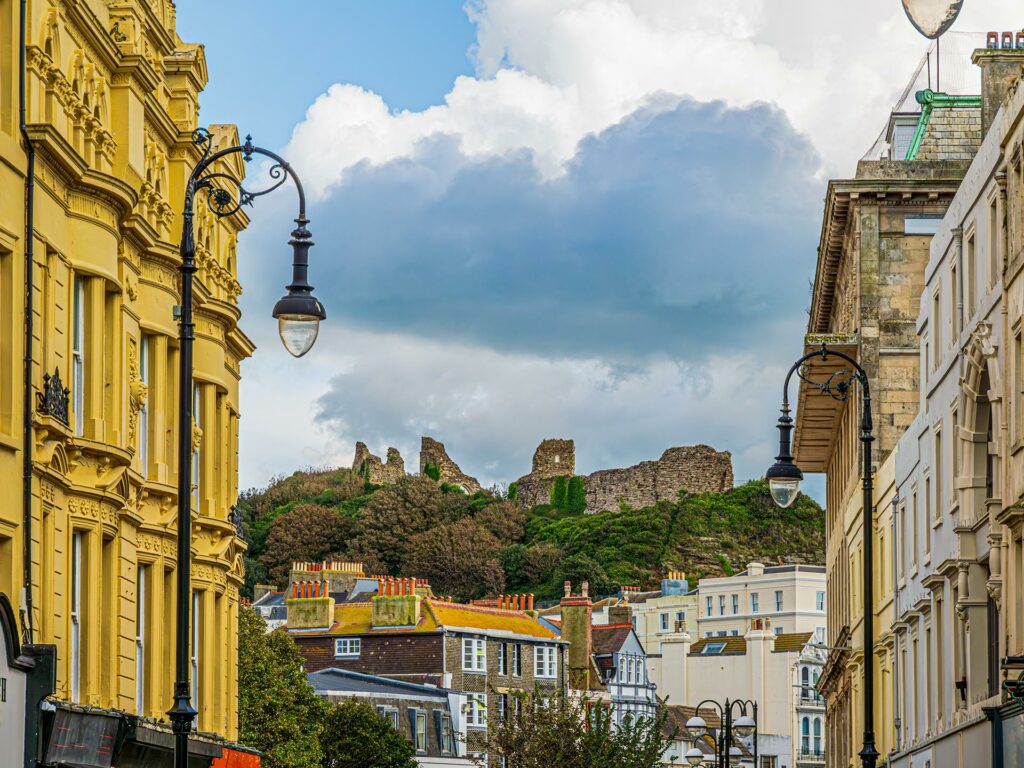
Hastings and Dover began as earth and timber, the motte-and-bailey type. There is more on the Sussex ones on our castles in East Sussex page.
Berkhamsted in Hertfordshire sometimes claims the title too. Historic England thinks it is probably slightly later than the three on the south coast. The first castles in the north were the two mottes William raised at York in 1068 and 1069, one of which now has Clifford’s Tower on top of it.
The oldest stone castle in Britain
Timber rots, which is why the oldest castle you can walk into is Chepstow. William FitzOsbern (the same man who rebuilt Ewyas Harold) began it in 1067 or soon after, on a cliff above the River Wye, and unlike nearly every other castle of those years it was built in stone from the start.

Chepstow is generally described as the oldest surviving stone fortification in Britain since the Romans, and Cadw’s guidebook calls its Great Tower “the earliest dateable secular stone building in Britain”. It also has what it claims are the oldest castle doors in Europe, more than 800 years old. They hung in the main gateway until 1962 and are now kept indoors.
In England the oldest stone castles are a few years behind. Rochester was among the first to be fortified in stone, between 1066 and 1088, and the White Tower at the Tower of London still has late eleventh-century work in its undercroft and chapel.
The oldest castle still lived in
The title belongs to Windsor. William the Conqueror chose the site and began building around 1070, and the Royal Collection Trust, which runs the castle, describes it as the oldest and largest occupied castle in the world. Forty monarchs have lived in it.

None of William’s castle is on show, though. It was timber, and Henry II rebuilt much of it in stone in the 1170s. What has lasted is the plan: the outer walls of today’s castle stand in the same position as William’s.
So is Windsor the oldest castle in the world, or even in England? No to both. Oldest occupied is the claim. The full story is on our Windsor Castle history page.
The oldest castle in Wales
Chepstow again. It was the first Norman castle in Wales and only just in Wales at all, since the river at the foot of its cliff is the border with England. It was the southernmost of a chain of castles the Normans built along the Welsh Marches, and most of what stands there now was added over the following two centuries. See Chepstow Castle for the detail, or our list of castles in Wales.
The oldest castle in Scotland
Scotland has two answers and, awkwardly, neither castle was in Scotland when it was built.
Cubbie Roo’s Castle, on the Orkney island of Wyre, is the earliest documented medieval stone castle in Scotland according to Historic Environment Scotland. The Orkneyinga Saga records a “fine stone castle” built there in 1145 by a Norse chieftain called Kolbein Hruga, when Orkney was Norse territory. Cubbie Roo is what his name turned into over the centuries, by way of a giant in Orkney folklore.
On the mainland the answer is Castle Sween in Argyll, which Historic Environment Scotland calls the oldest standing castle on the Scottish mainland that can be dated with confidence. It was probably built in the 1100s by Suibhne the Red (Suibhne is pronounced Sween, hence the name), at a time when Argyll lay outside the kingdom of Scotland.
Aberdour Castle in Fife held the title for a while and is now thought to be slightly later than Sween. More Scottish castles are on our castles in Scotland page.
The oldest castle in Northern Ireland
The usual answer is Carrickfergus, on the north shore of Belfast Lough. John de Courcy began it in 1177 as his headquarters after conquering eastern Ulster, and it stayed in military use until 1928.
Why hillforts and Roman forts don’t count
Britain has fortifications far older than any of these: Iron Age hillforts, Roman forts, Saxon burhs. They are left out because a castle, in the sense historians use the word, is the fortified home of a lord, and that idea arrived with the Normans. Our page on what a castle is goes into the definition.
The line blurs where the Normans reused something older. At Marlborough in Wiltshire they made a motte out of a Neolithic mound dated to around 2400 BC, which makes it the oldest thing in England with a castle on it, though it was not a castle for its first three and a half thousand years. It is not open to the public.
For what happened to castles after these first ones, see our history of castles in Great Britain.